



Pre-Owned Tag Heuer Watches
Established 1860Started by Edouard Heuer under the name Heuer, the TAG Heuer brand came into being after a merger with TAG, manufacturers of technology used in Formula 1. Many TAG Heuer watches remain influenced by the sporting universe—from motor sports to golf— and we have a superb selection of pre-owned TAG Heuer models to purchase.
View All


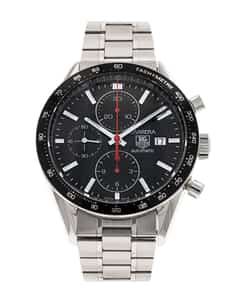


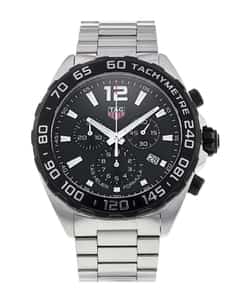


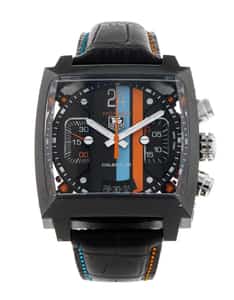


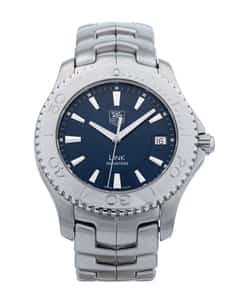






Tag Heuer History
TAG Heuer is a company with its roots firmly planted in motorsport. The brand originally started off as just Heuer, under the leadership of Edouard Heuer; a watchmaker with a passion for innovation, he started making watches at the tender age of 20. Such was his enthusiasm for his work, that with just nine years under his belt making watches, he had already patented one of the first crown winding mechanisms. Not twenty years later, he had also patented the oscillating pinion: a compact component that allowed precise engagement of the chronograph function.
This interest in chronographs founded the company’s penchant for timing equipment. After Edouard’s death in 1892, the brand continued to develop timing products, the ‘Time of Trip’ dashboard mounted stopwatch receiving its patent in 1911. The main, centrally-mounted hands of the instrument displayed the time, and an additional pair of smaller hands counted elapsed time. A top-mounted crown started, stopped and reset the smaller hands. This developed into the first wrist-worn chronograph, released in 1914. Adapted from a pocket watch, the crown was mounted at the 12 o’clock position, and accuracy was improved to 1/100th of a second. A timing split function was added soon after, which allowed intervals between competitors to be recorded.
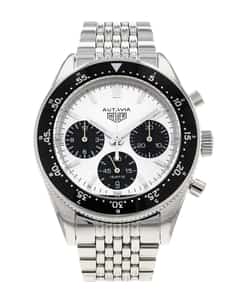
The brand’s dashboard chronograph evolved through the 1980s into several variations: the Super Autavia, a name derived from the two main users of the instrument, the auto and aviation industries; the Master Time, which contained a movement that could run for eight days without winding; the Monte-Carlo, a 12-hour stopwatch; the Sebring, a 60-minute split-second timer; and the Auto-Rallye, a 60-minute stopwatch.
The connection that the company had with motorsport eventually spread to the pinnacle of racing, Formula 1. Watches such as the Autavia, Carrera, Monaco, Silverstone and Monza followed. The Formula 1 link was cemented with the amalgamation of TAG and Heuer as TAG Heuer. TAG (Techniques d'Avant Garde) manufactured technology used in Formula 1, such as the ceramic turbochargers that gave the cars their fearsome reputation, and this union gave rise to watches such as the Kirium, F1 and Link.
Motorsport wasn’t the only industry that displayed an interest in the brand’s watches. John Glenn, the astronaut piloting the Mercury Atlas 6 spacecraft, used his Heuer stopwatch to time the first manned orbit around Earth, making it the first Swiss watch in space. The aviation industry also relied heavily on the brand’s watches: the German air force commissioned many timepieces for their pilots throughout the world wars and well into the 1960s. A notable development in this field was the Bundeswehr, a flyback chronograph. The company also developed dive watches, with the Aquaracer, Professional and Aquagraph being prime examples. Stepping into the future, the Connected fuses horology with technology for a touchscreen smart watch.
TAG Heuer watches have always had an understated and desirable cool about them. For all their functionality within the various industries that use them, their clean designs and usable features have made them as sought after by the public as by the professionals. And, let's face it—if Steve McQueen wore one, they’ve got to be cool.
